How to hire brand designer in 2026: easy steps for your business
How to hire brand designer talent in 2026: what the three roles cost, where to find them, how to vet a portfolio, and how to run the project.
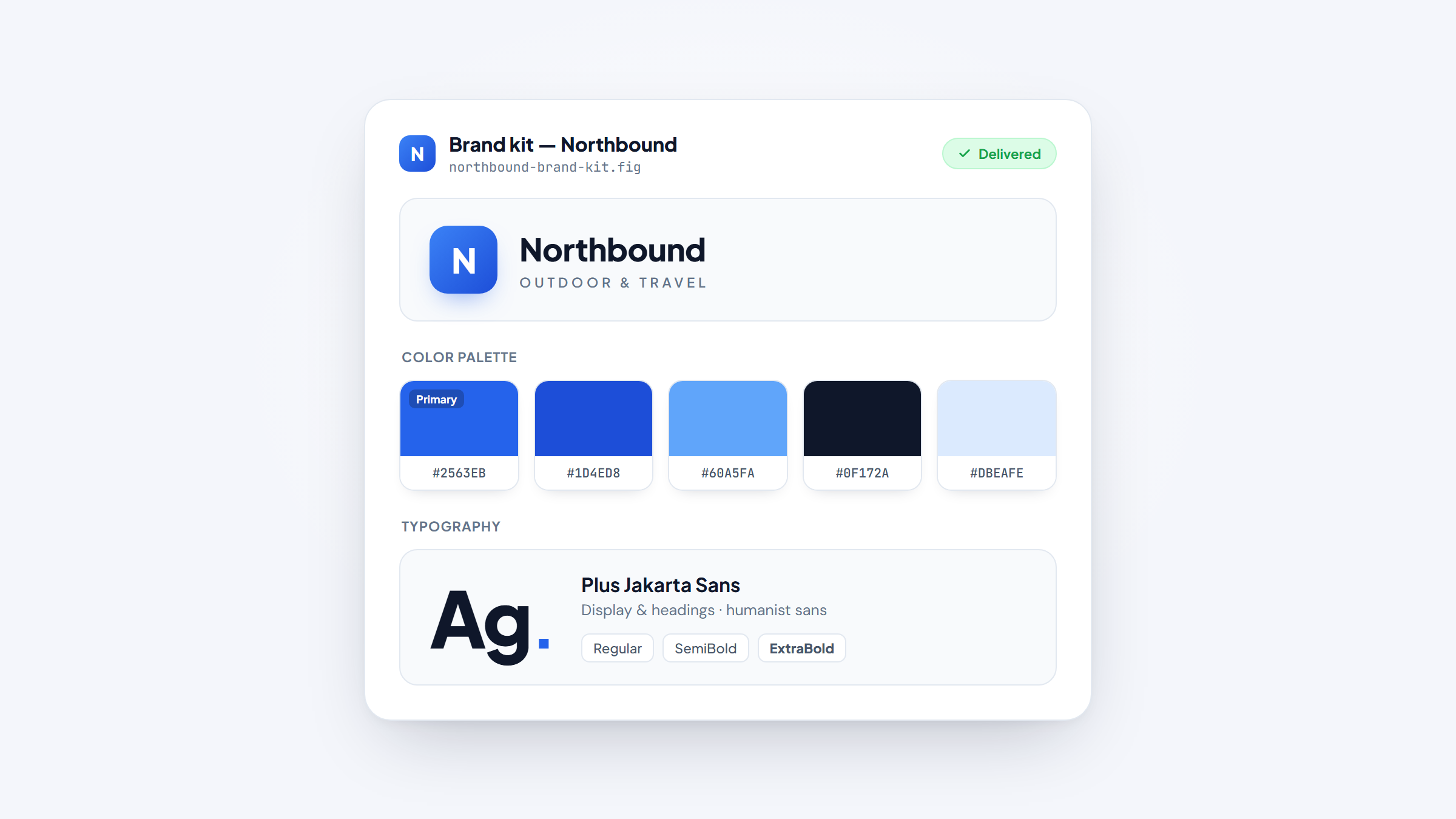
Your brand is more than a logo. It is the promise people remember before they read a word of your copy, and the right brand designer sets that identity for years. Get the hire wrong and you burn a budget, ship a look that dates in a season, and pay a second designer to fix it.
Most founders struggle here because "brand designer" gets used for three different jobs, prices swing from $50 to $200,000, and the best talent rarely shows up where you first go looking. This guide walks you through it step by step: who you're actually hiring, what to budget, where to find them, how to vet a portfolio, and how to run the project so the work lands and stays yours.
Why brand design is worth the money
Good design is not decoration; it moves revenue. McKinsey tracked 300 companies over five years and found that the top quartile of design performers grew revenue 32 percentage points faster than their peers, with total returns to shareholders up 56 percentage points faster. That gap comes from treating design as a business function, not a coat of paint.
The catch is that visuals are the last step, not the first. If you brief a designer on a logo before you know your positioning, your audience, and your business goals, you will get something that looks fine and means nothing. Most companies that skip the strategy layer end up redoing their identity within 6 to 12 months, which is the most expensive way to save time.
So the real investment is in getting the thinking right first, then hiring someone who can translate it into a system. That is also why many teams choose to hire brand designer support through a service like ours at Awesomic, where a vetted designer picks up brand and marketing work on a flat monthly plan instead of a one-off project fee. More on where that fits later.
If you want the wider view of models and providers before you commit, our rundown of design service models breaks down the trade-offs.
Step 1: know who you're actually hiring
The word "designer" hides three distinct roles, and mixing them up is the most common hiring mistake. A brand designer builds the full visual identity system: logo, colors, typography, and the guidelines that hold it together, working from your strategy, one client at a time, usually over 4 to 8 weeks.
A graphic designer executes individual assets inside that system, an ad, a deck, a social post, and works faster and project by project. If that is the role you actually need, our steps to hire a graphic designer cover it in full.
A brand strategist or brand consultant sits above both. As the branding firm Finch Brands puts it, a brand is not a logo; you hire a brand consultant to diagnose the positioning, the audience, and the business alignment, which is the input everyone else designs from.
The order matters. Strategy first, identity design second, individual graphics third. If you hire a graphic designer to knock out marketing assets before anyone has defined the brand, you buy a pile of pieces that don't add up to a whole, then pay again to redo them once the real identity exists.
Here is how the three roles compare so you can match the hire to the job in front of you.
Role | What they deliver | When you need them |
|---|---|---|
Brand strategist / consultant | Positioning, audience, messaging, business alignment | Growth has stalled, a merger, or entering a new market |
Brand designer | Full identity system: logo suite, colors, typography, guidelines | You have positioning and need the visual identity built |
Graphic designer | Individual assets inside an existing system | The brand exists and you need ongoing production |
If you already know you want the identity system built and nothing above it, our hire a brand designer page shows what that scope looks like in practice. Pin the role down before you talk price, because each one costs a different amount.
Step 2: define your scope before you brief anyone
Knowing how to hire a brand identity designer starts with scope. "Brand identity" gets used loosely, so define it for your own project before you ask for a quote. In this guide, brand identity means the whole visual system, not just a mark. That distinction alone changes your budget by an order of magnitude.
At the small end, you might only need a logo suite: the primary logo, secondary marks, and every file format for print and screen. If that is all you're after, our hire a logo designer page shows what a logo-only scope covers.
A full identity adds a color palette, a type system, and a brand guidelines PDF that tells anyone how to use them. Brand strategy sits above all of it and covers positioning and messaging, not pixels.
Write down which of those three you are buying. A logo alone is a fine start for a pre-revenue side project; a funded startup going to market needs the full system so every touchpoint looks like it came from the same company. Being specific here is what stops a designer from guessing and stops you from overpaying for work you didn't need.
Once you know the scope, you can put a real number on it, which is the next and trickiest step.
What it costs to hire brand designer talent
There is no single price for brand design, and averaging the range gives you a useless number. To set a benchmark for design talent generally, the Bureau of Labor Statistics puts the median pay for graphic designers at $61,300 a year as of May 2024, with the top 10% above $103,030.
There is no separate government code for "brand designer," so treat that as a floor for skilled design labor, not the price of a full identity.
Project pricing splits into clean tiers, and where you land depends on who does the work. Marketplace and DIY logos sit under $1,000 and often get redone.
Established solo experts and small studios climb into five figures fast; the designer Jessica Jones, for example, lists a full brand identity system at $17,000 and up. At the top, enterprise agencies run six figures for a global rebrand.
Here is the shape of the market so you can find your tier.
Tier | Typical cost | Best for |
|---|---|---|
DIY / marketplace logo | Under $1,000 | Pre-revenue tests, throwaway projects |
Freelance brand identity | $2,000 to $8,000 (solo experts $17,000+) | Early startups with a defined scope |
Boutique / small agency | $5,000 to $20,000 | Funded companies going to market |
Premium / enterprise agency | $30,000 to $200,000+ | Large rebrands, multi-market rollouts |
Design subscription | $400 to $3,000+ per month, flat | Ongoing brand plus marketing work |
The subscription row is a different model, not a cheaper project. Instead of a one-time fee, you pay a flat monthly rate for continuous work with unlimited revisions and no rush charges, which fits companies that need brand and marketing assets every week, not once.
How much should you actually put aside? An agency owner on Reddit shared real packages, roughly $1,500 for a logo, one-page site, and cards, $5,000 for a logo plus guidelines, and $15,000 and up for custom work.
His rule of thumb: spend no more than 5% to 15% of gross revenue on marketing, and only a slice of that on branding, so a company earning $100,000 a year has no business dropping $5,000 on a rebrand yet. For a rough early-stage anchor, budget around 5% to 10% of projected revenue. Treat that as anecdotal, not gospel, but it keeps you honest.
With a number in hand, you can go find the person to spend it on.
Step 3: where to find brand designers, including offshore
The best places to hire brand designer talent are where designers show their work. Behance and Dribbble let you filter by style so you can shortlist people whose past identities already look like the direction you want.
Referrals from founders you trust are even better, because they come with a story about how the person actually worked. Personal portfolio sites round out the picture, since serious designers keep case studies there, not just thumbnails.
One warning from the people who do this for a living. One experienced designer on Reddit made the point bluntly: top-tier talent doesn't hang around contest sites or race-to-the-bottom marketplaces.
For identity work (not one-off graphics), look for full identity systems in the portfolio, meet the person, get them to walk you through their process, and treat the engagement like a real contract with a deposit and staged payments. It is one comment, so weigh it as experience rather than data, but it matches what most studios will tell you.
Offshore hiring is a real lever if you do it properly. If you hire offshore brand identity designer talent, a vetted dedicated hire is not the same as a random marketplace freelancer: expect roughly $800 to $2,000 a month for a full-time hire versus $3,000 to $10,000 a month for a local agency, a claimed 60% to 80% saving.
The saving only holds if you vet hard and protect the work.
Before you sign an offshore designer, run these checks.
- Review a portfolio with at least one full identity system, not just logos.
- Give a short paid skills test or a live timed brief to see how they think under a deadline.
- Confirm strong written and spoken English so feedback loops don't stall.
- Ask for two client references and actually call them.
- Match the time zone to your workflow: Colombia sits near EST, South Africa is about 6 hours ahead, the Philippines runs 12 to 13 hours async.
Whichever lane you pick, the same rule holds: protect your intellectual property with a written work-for-hire clause and an NDA so the finished identity belongs to you, not the person who drew it. Sourcing well only pays off if you then judge the work correctly, which is the next step.
Step 4: how to evaluate a brand designer's portfolio
When you set out to hire brand designer talent, a pretty logo tells you almost nothing. What you are looking for is evidence that the person can build and think, not just decorate, so read every portfolio piece as a system rather than a picture.
Work through this checklist as you review each candidate.
- Look for complete identity systems, logo, color, type, and guidelines, not a wall of standalone logos.
- Find a defined process in their case studies: discovery, strategy, concept, refinement, and delivery.
- Check that they pushed back on a client's bad instinct somewhere, which shows judgment, not just service.
- Confirm they deliver brand guidelines and every file format, not a single flattened image.
- See whether their past work spans a few industries, so the style is a choice, not their only trick.
Ask each shortlisted designer to walk you through one project start to finish. You want to hear why they made specific calls, how they handled feedback, and what changed between the first concept and the final files.
A designer who can explain the reasoning behind a color choice is worth more than one who just says the client liked it. The best brand designer for hire will volunteer that reasoning without being asked.
Watch the tools too. Adobe Creative Suite is still the professional standard for identity work; a Canva-only portfolio usually can't match the range a full system needs. Once you have a designer you trust, the last step is running the project so it actually ships.
Step 5: brief, contract, and rollout
A clear brief is the difference between three revision rounds and thirteen. Write it before the project starts and keep it tight, then use a simple sequence to run the engagement from kickoff to handoff.
- Write a creative brief covering your objectives, your audience, a short competitive analysis, and two or three visual references you like and why.
- Agree a realistic timeline. A full identity runs 4 to 8 weeks for a focused freelancer and can stretch past 3 months at an agency, so don't expect a system overnight.
- Set payment terms with a deposit up front and the balance staged against milestones, which protects both sides.
- Cap revisions in rounds. Three to five rounds is standard, and naming that number keeps scope from creeping.
- Confirm the final deliverables in writing: every logo file format plus the brand guidelines PDF, so nothing is missing at handoff.
Speed depends on the model you chose. A dedicated freelancer or agency needs those weeks because they are building a system from scratch.
On a subscription like ours at Awesomic, we match you to a vetted designer in up to 24 hours, but that is kickoff speed, not delivery: the brand system itself still takes real design time, the same as anywhere else. What you save is the hiring cycle, not the craft.
If you would rather compare full studios before deciding, our list of brand design agencies is a useful starting point. Whatever you choose, get the brief and the contract right and the rollout mostly runs itself.
Direct hire vs a subscription for ongoing brand work
A one-time project hire is right when you need a discrete identity built and then handed off. You brief a designer, they deliver the system, and you own it. That is a brand designer direct hire, and for a company that only needs the identity once, it is the cleanest path.
The math changes when brand work never really stops. New landing pages, pitch decks, social templates, campaign assets, and the occasional refresh add up to steady demand, and hiring a full-time brand designer for that in the US can cost well over $61,300 a year once you add benefits.
A one-off freelancer means re-briefing a new person every few months, with the context lost each time.
This is where a subscription earns its place. On our 1-to-1 plan at Awesomic, you get a dedicated designer plus a project manager on a flat monthly fee, with unlimited revisions, drawn from talent in the top 0.82% we accept.
Brand work sits under our Graphic Pack at $1,490 a month or the All-in-one plan at $2,995 a month, so ongoing identity and marketing production is one predictable line item instead of a string of quotes.
You can see how the model works across teams in our design as a service breakdown, or the pricing math in our graphic design subscription guide.
For most growing companies the answer is a mix: a focused project to build the core identity, then a subscription to keep it alive across everything you ship. If your needs lean toward the product side, the same logic applies when you hire a product designer or hire a UX designer for ongoing app and interface work.
If you are still weighing the general call on when and how to bring designers on, our guide to hiring designers covers the wider decision.
The right way to hire brand designer talent comes down to a short discipline: sort out your strategy first, hire on systems thinking rather than a single nice logo, budget by your revenue stage, and lock down ownership before work starts.
Do that and your brand becomes an asset that compounds instead of a cost you keep repaying. If you want to see how a dedicated designer and PM could carry your brand work on a flat monthly plan, Book demo and we'll walk you through it.
Frequently asked questions
Start by fixing your strategy: your positioning, audience, and goals come before any visual. Then define the scope (logo, full identity, or strategy), set a budget by tier, and source candidates from Behance, Dribbble, referrals, and portfolio sites rather than contest platforms. Shortlist people whose portfolios show complete identity systems and a clear process, ask each to walk you through a past project, and check references. Finish with a written brief, a deposit-and-milestone contract, capped revision rounds, and a work-for-hire clause so the finished brand belongs to you.

Still comparing design subscriptions?
Filter 50 vetted companies by pricing, turnaround, and the type of design work you need. No signup, no sales calls.