How to hire product designer in 2026: a step-by-step plan
Learn how to hire product designer talent in 2026: pin down the role, skew senior, budget by seniority, and match a vetted designer in days, not months.
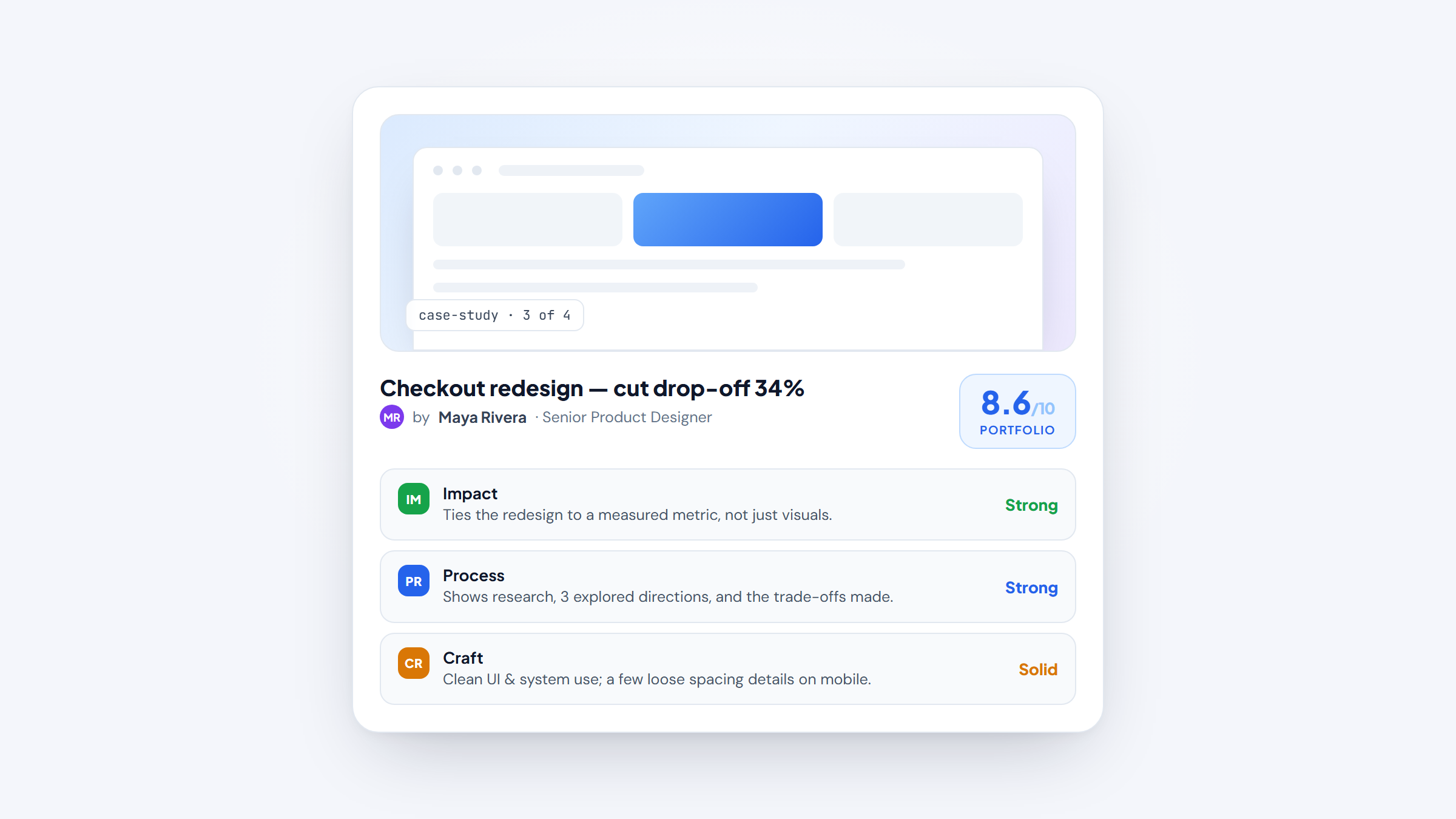
A good product designer decides whether people understand your product in the first thirty seconds or bounce. The wrong hire, or the right person at the wrong seniority, can cost you a full quarter of runway before you notice the mockups aren't turning into shipped screens.
Design isn't decoration on a working product; it's part of whether the product works at all. In a five-year study of 300 companies, McKinsey found the top quarter on its design index grew revenue 32 percentage points faster than their peers, and returns to shareholders 56 percentage points higher. That gap is why getting this hire right matters more than most founders expect.
This guide walks the whole thing end to end: naming the exact role you need, picking seniority, choosing how to hire product designer talent, what it should cost, and how to source, evaluate, and test a designer before you commit. Follow it in order and you'll skip the two mistakes that sink most first hires.
Step 1: know which "product designer" you're actually hiring
The title is overloaded, and that's the single most common reason a hire goes sideways. When founders say "product designer," they can mean any of four jobs.
There's the digital/software generalist who does both the thinking and the pixels for apps and websites. There's the UI-only specialist who makes interfaces look right but doesn't run research. There's the UX-only researcher who studies users and maps flows but may not push polished screens. And there's the industrial designer who shapes physical, manufactured objects in 3D.
This article is about the first one: a digital, software product designer for SaaS, edtech, fintech, and similar products. If you want to hire a product designer for development of a web or mobile app, this is the profile you're after. If you're building a physical device and need someone who understands injection molding and CAD, that's industrial design, a different field with different portfolios, and most of the advice below won't map cleanly.
If you mainly need user research and usability testing, that leans UX, closer to a research hire than a build-and-ship generalist.
Naming the role narrows everything downstream: where you post, what a portfolio should show, and what you pay. It also stops the classic mismatch where a founder interviews visual designers for a job that's really about product strategy, then wonders why the finalists can't reason about tradeoffs.
Getting a first designer wrong is expensive to unwind, which is one reason a growing number of teams start with a dedicated designer on subscription (that's the model we run at Awesomic) while they figure out exactly what the long-term role should be. More on that once we've sorted seniority and cost.
Step 2: decide seniority, and why your first hire should skew senior
For your first or founding design hire, the instinct to save money with a junior usually backfires. The case to hire senior product designer talent early is stronger than it looks. A junior needs direction you don't have time to give, and design direction is exactly the thing you're hiring for. Your first designer often works with no design manager above them, which means they set the bar, not follow one.
The market has moved the same way. In Figma's 2026 State of the Designer report, 56% of managers said demand for senior designers is rising, against 25% for juniors. AI tools have absorbed a lot of the entry-level busywork, so the value has shifted toward judgment, problem framing, and knowing what to build. That's senior work.
What you actually want in a founding designer is a mid-career, lead-level generalist: someone who can run UX strategy and produce clean UI, ships fast without a heavy process, and has startup or agency reps rather than a big-company pedigree that's slow and layered. Here's what a hire like that brings that a junior can't yet:
- Frames the real problem before touching Figma, so you're not paying for beautiful screens that solve the wrong thing.
- Runs from rough research to shipped interface without a manager translating between the two.
- Makes and defends tradeoffs on scope, so features fit your timeline instead of blowing it.
- Builds reusable components and a simple system, which keeps the next ten screens consistent and fast.
- Reads founder chemistry and ambiguity well, because early-stage work has no spec to hand off.
None of this means you'll never hire juniors. Once a senior sets the direction and the system, juniors become a smart way to scale execution. The order just matters: senior first, then support. If you're weighing seniority for a specialist track instead, our companion guide on how to hire a UX designer covers the research-heavy version of this same call.
Step 3: choose your engagement model
Once you know the role and seniority, decide how you'll actually hire product designer talent, because this choice of engagement model drives both cost and speed. There are three real options, and they suit different moments.
A direct in-house hire gives you a permanent team member, but it's the slowest and carries hidden cost. On top of base salary, expect 20-40% overhead for benefits, equipment, taxes, and insurance, and plan for 2-3 months to fill the role once you count sourcing, interviewing, and notice periods.
A freelancer is faster to start and flexible, though once you add rework, availability gaps, and the coordination tax of a split-attention contractor, it often isn't cheaper than a full-timer. A dedicated design subscription sits between them: a fixed monthly fee, one designer focused on your product, and a start measured in days rather than months.
Engagement model | Typical cost | Speed to start | Best fit |
|---|---|---|---|
Direct in-house hire | Base salary + 20-40% overhead | 2-3 months | Building a permanent, growing design team |
Freelancer | Hourly or per-project | Days to weeks | One-off projects with tight, fixed scope |
Dedicated design subscription | Fixed monthly fee | 1-2 days | Ongoing product work without a full-time hire |
That 2-3-months-versus-1-2-days gap is the whole reason the subscription model exists. It's also where we fit: our dedicated designer tier pairs you with full-time or part-time vetted talent plus a project manager, matched in up to 24 hours, with unlimited revisions. Teams tell us it's the fastest way to hire a dedicated designer for your edtech product and start right away, without a two-month search.
For the tradeoffs of keeping design external longer term, we wrote up product design outsourcing and how the subscription model compares to a direct hire.
The model you pick isn't permanent. Plenty of teams start with a subscription or freelancer to move fast, then bring a designer in-house once the role and workload are proven.
What a product designer actually costs
There's no clean government salary line for "product designer," so budgets get set on guesswork. The closest official occupation is "Web and Digital Interface Designers," where May 2023 BLS data from the Bureau of Labor Statistics puts the median at $98,540 a year ($47.37 an hour), with the top 10% above $176,490. Treat that as a floor-to-ceiling frame, not a target.
Salary sites disagree wildly for the same title, which is why quoting one number is a trap. PayScale lands near $96K, Glassdoor around $118K, Indeed about $146K, and Levels.fyi near $161K in total comp (skewed high by big-tech equity). The honest move is to budget in ranges by seniority and hire against the range, not a single figure.
Seniority | Experience | Salary range | Freelance hourly |
|---|---|---|---|
Junior | 0-2 years | $75K-$100K | $25-$90 |
Mid | 2-5 years | $100K-$140K | $50-$130 |
Senior | 5-8 years | $140K-$185K | $80-$180 |
Staff / Principal | 8+ years | $185K-$250K+ | $120-$250+ |
Location still moves these numbers, and lowballing is a false economy. One founder of an eight-person Austin SaaS team described on Reddit posting a $70K-$85K range for a mid-level product designer, then getting three months of silence and spam, with the few finalists ghosting.
The thread's read was blunt and anecdotal but consistent: that range sits below market, senior designers in Austin start around $110K-$120K, and New York runs past $150K. If your budget is genuinely capped, the realistic fix is a fractional or remote designer, not a full-time senior at a junior price.
Set the range before you post, and you'll attract people who match it instead of burning a quarter proving the range was wrong.
Step 4: write the job description and hire product designer talent
A vague job description is why generic boards return noise. If you ask for "a product designer with 3+ years of experience," you'll get a stack of graphic designers who don't fit.
A good description leads with the actual problems the person will own in their first three to six months, names the specific credentials that matter, and, just as usefully, says who the role is not for. That last part filters harder than any requirement line.
Once the description is tight, hire product designer talent through the right channels rather than blasting every job board:
- Post to Dribbble first, which tends to convert better for product design roles than Behance.
- Search Contra and Upwork for freelance and contract talent you can start small with.
- Use a vetted matching service when you want pre-screened portfolios instead of an open inbox.
- Ask your investors and design friends for warm intros, still the highest-signal channel.
That third option matters more than it looks. The same Reddit founder, after four months of LinkedIn and Indeed noise, switched to a matching service and hired from pre-vetted portfolios in about three weeks.
The lesson, anecdotal but common, is that generic boards make you the filter, while a vetted match makes someone else do the filtering first. That's the exact gap our SaaS design matching closes: we screen to the top 0.82% of applicants so you review a shortlist, not a slush pile.
Whichever channel you use, the goal is the same: fewer, stronger candidates you can actually evaluate in depth, not an inbox full of every product designer for hire on the internet.
Step 5: evaluate the portfolio for process, not polish
A portfolio full of gorgeous final screens tells you almost nothing. Anyone can make one screen look good. What you're buying is judgment, so read for how the person thinks, not just what they shipped. Pretty work with no reasoning behind it is a warning sign.
How to read a portfolio in one sitting
Work through each case study the same way, and you'll spot the difference between a decorator and a designer fast.
- Find the shipped products first, and look for outcome numbers (activation up, support tickets down), not just "redesigned the dashboard."
- Read for the tradeoff: what did they cut or defer, and why? Real product work has constraints.
- Check for systems thinking, reusable components, patterns, and a "what if we redesigned this" exploration.
- Ask for a live walkthrough of one project, so they narrate the decisions instead of showing you the deck.
- Separate design from pure research: if you need someone who ships interfaces, confirm the portfolio shows built product, not only user-research reports.
That last check matters when you're deciding whether to hire a product designer or hire a product design researcher. Both are valuable, but they're different jobs, and a research-only portfolio won't tell you whether the person can push clean, shippable screens.
A few patterns should make you pause: case studies that are all final screens and no process, portfolios made entirely of concept work that never shipped, and pedigree used as a substitute for craft (a famous logo on the resume isn't the same as good decisions on your product). Treat those as prompts to dig deeper before you move anyone forward.
Step 6: run a paid design challenge, then decide
Interviews and portfolios still leave a gap: how does this person work on your product, with your constraints? A short paid design challenge closes it, and paying for it keeps the exercise fair and serious. Skip unpaid "test projects"; strong designers walk away from those, and you lose the best candidates.
Keep the challenge realistic and small so it respects everyone's time:
- Pick one real, anonymized feature from your roadmap, stripped of anything confidential.
- Give three to four days of calendar time for what should be about five hours of actual work.
- Ask for a click-through mockup plus a short video walkthrough of their thinking.
- Score the reasoning and the questions they asked as heavily as the visual output.
From there, the decision comes down to how you want to engage them, and you don't have to commit to full-time on day one. A direct hire suits a proven, ongoing need, while a contract engagement fits a defined project or a budget that can't carry a salary and 20-40% overhead yet.
Contract-to-hire is the low-risk middle: work together on real deliverables for a month or two, then convert if it clicks. If you're leaning toward flexible from the start and want to hire freelance product designer talent, our note on how to hire a freelance designer covers scoping a contract so it doesn't sprawl.
Whichever path you choose, decide on evidence from real work, not on a good interview alone.
Keep the designer you worked so hard to hire
Hiring is only half the job; the expensive part is losing a good designer six months in and starting over. And designers rarely leave over pay. They leave when they become a "decoration department," handed final-stage tickets with no research budget, no say in what gets built, and no ownership of outcomes.
The fix is ownership. Bring your designer into product decisions early, give them room to talk to users, and let them influence the roadmap instead of just skinning it. A designer who helped decide what to build stays to see it land. One who only pushes pixels updates their portfolio and moves on.
This is also where an embedded, dedicated model earns its keep. With our dedicated design setup, the same designer stays with your product across projects, so they build the context a rotating cast of freelancers never accumulates.
Our clients see up to 60% fewer revision cycles once a designer knows the product deeply, which is retention paying off in fewer do-overs. For teams scaling past one designer, we wrote up how to structure a growing function in scaling design ops.
Whether your designer is in-house or embedded, the retention play is the same: give them real problems and real ownership, and the good ones stay.
Hire product designer talent well and the rest of the product gets easier: fewer rebuilds, faster shipping, a clearer interface. Name the exact role, skew senior on your first hire, budget in honest ranges, match fast instead of trawling job boards, test with real paid work, and hand over genuine ownership once they're in.
If you'd rather skip the two-month search and start with a vetted, dedicated designer matched in up to 24 hours, Book demo and we'll show you how it works. Founders who've been through it, including many YC-backed teams we work with, tell us the same thing: getting design right early is the cheapest speed you'll ever buy.
If you need the brand-and-identity side instead of product UI, our guide to hiring a brand designer picks up there.
Frequently asked questions
Start by naming the exact role: a digital/software generalist, a UI or UX specialist, or an industrial designer, because each needs a different search. Decide seniority (skew senior for a first hire), set a salary range, and pick an engagement model: direct hire, freelancer, or dedicated subscription. Then write a job description that leads with the first six months of problems, source from Dribbble and vetted matching rather than only generic boards, evaluate portfolios for process over polish, and run a short paid design challenge before you commit. Deciding on real work instead of interviews alone is what separates a good hire from an expensive miss.

Still comparing design subscriptions?
Filter 50 vetted companies by pricing, turnaround, and the type of design work you need. No signup, no sales calls.